✕
What issue are you experiencing?
Cracks, water intrusion, crawl space moisture, settlement, etc.
Cracks, water intrusion, crawl space moisture, settlement, etc.

If you’ve ever been in the Midwest just before a thunderstorm, you know how intense humidity can be. The air is a damp sweaty cloth wrapped around you like a boa constrictor. It weighs you down and slowly compresses you, until you feel both smothered and drowned at the same time. It’s hard to breathe, you’re sweaty and uncomfortable, and every moment spent in this haze lasts three times as long as it should.
This is NOT a feeling you want in your house. We all know how critical good sleep is for our overall health, and all the studies agree: the best sleep conditions are between 60° and 70° Fahrenheit with 50% humidity1. The best way to achieve these conditions is a fully operational HVAC unit and a dehumidifier.
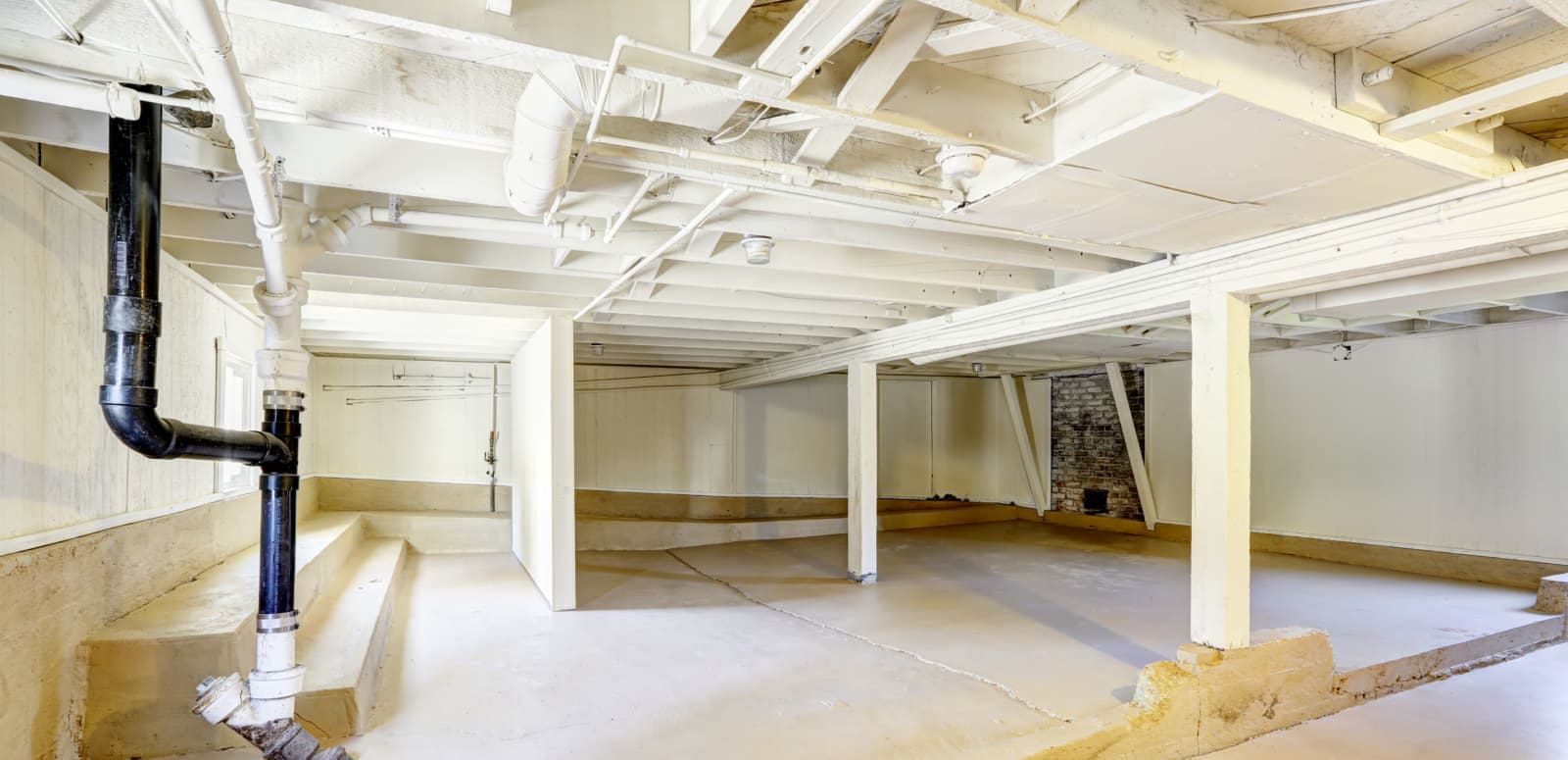
Since opening our doors in 1996, Acculevel has installed water drainage into thousands of homes, and many of these have included whole-house dehumidifiers. A dehumidifier is an important component in waterproofing your basement or crawl space, and they are an absolute necessity for crawlspace encapsulation.
Dehumidifiers reduce humidity by pulling moisture from the air. The air is filtered and cooled, and this process converts the humidity into condensation. As the condensation accumulates, it’s stored in a tank that must be emptied, or drained through a water line that connects to your sump pump.
You may be tempted to use your HVAC system to do the work of a dehumidifier. Some HVAC systems even offer these as add-on options. But we don’t recommend this as a practical solution. Your HVAC unit’s primary function is not to remove humidity; using it to do so is going to cause it to work harder (and differently) than it was intended to do. It’s far less expensive to buy a dehumidifier than it is to repair or replace an HVAC that gets overworked and fails.
You should install a dehumidifier in your home for three major reasons: it improves your health, enhances your environment, and saves you money. This is especially true if you have a Michigan basement, where the combination of partially finished space and exposed foundation walls makes proper humidity control essential.
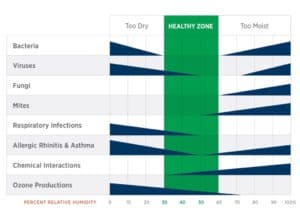 Information taken from a study performed by ASHRAE2 (American Society of Heating, Refrigerating and Air-Conditioning Engineers.)
The benefits of a dehumidifier for your home make sense. But what are the other options for your home? Can you choose a room-size, or portable, dehumidifier? Yes, you can. But there are 3 major drawbacks.
The biggest benefit to a portable dehumidifier is that it costs less than a house-sized unit. Everyone has a budget, and we recognize that a higher initial cost can be unpleasant. We recommend that you consider this an investment that protects your entire home and its furnishings.
It will ultimately pay for itself in reduced energy costs and improved quality of living. Here at Acculevel, we install dehumidifiers with a capacity of 95 pints (45 liters) for $2175-$2650 (cost includes installation). This model comes with a 5 year warranty, is made in America, and has an average life span of about 15 years.
This picture was taken by an Acculevel crew member after installation.
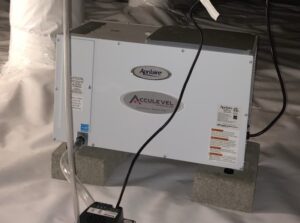
This shows a fully encapsulated crawl space with a dehumidifier. The drainage line connects directly to the sump pump system, so there is no tank to empty.
Dehumidifiers are sold by capacity. The capacity refers to the amount of moisture that the model can remove in a single day. You need to know two things to calculate the necessary capacity: condition and square footage.
The condition may also be referred to as moisture level or dampness level, depending on which manufacturer’s chart you’re reading. Condition can be somewhat subjective, especially if your home has a crawl space and you aren’t able to observe the surfaces in it. If you would like specific data, you can purchase a hygrometer at your local hardware store and get a precise reading.
[box type="info"] FYI: The ideal RHL (relative humidity level) is between 30%-50%. [/box]
Your home’s square footage is probably common knowledge to you. If you don’t remember it and don’t want to run the numbers, square footage should be clearly indicated in your home’s realty paperwork. However, if you have a crawl space, you will probably need to calculate and add that area’s footage; most listings and inspection reports don’t include crawl spaces in a home’s square footage because it’s not ‘living’ space.
For our example, we’ll use a 2500 square foot home:
| Condition | Typical Symptoms | Capacity |
| Slightly Damp 50%-60% | During humid weather, the air feels clammy and has musty odors | 26 pints (12 liters) |
| Damp 60%-70% | Always feels clammy, with odors and some moist patches in the basement/crawl space | 32 pints (15 liters) |
| Very Damp 70%-80% | Moisture is collecting or beading on surfaces in basement/crawl space | 38 pints (18 liters) |
| Wet 80%-100% | Standing water in basement/crawl space* | 44 pints (21 liters) |
We suggest that you buy a model a level above what you need. This way your unit won't have to operate at maximum speed to maintain a good RHL. This is good for you and the dehumidifier because:
We also urge you to have your foundation evaluated, if you have a wet basement or crawl space. This level of humidity is not healthy for you or your home. We have a basement waterproofing guide, or search our blog for information about how a wet crawl space can damage your home.
If you are interested in waterproofing, having a dehumidifier installed in your home, or other foundation repairs: locate an experienced local foundation company, and make an appointment. If you’re wondering what is a Michigan basement, or how its unique design affects moisture control, working with experts who understand these spaces is essential.
Before you sign a contract for any service, you should always verify the company is reputable, insured, and accredited by the Better Business Bureau.
If you live in Indiana or the surrounding states, contact Acculevel. Established in 1996, we specialize in waterproofing and foundation repairs.
Resources:
1 https://www.sleep.org/
2 https://www.ashrae.org/about
[DISPLAY_ULTIMATE_SOCIAL_ICONS]