✕
What issue are you experiencing?
Cracks, water intrusion, crawl space moisture, settlement, etc.
Cracks, water intrusion, crawl space moisture, settlement, etc.
Imagine you repainted your living room. You chose a lovely shade, a color that fills you with a feeling of serenity. You’ve done the job well: you stripped off the outdated wallpaper, repaired cracks in the drywall, applied 2 coats of primer and painted. Now it’s time to enjoy the space; you’re relaxing in your favorite chair- debating if you want a nap- when you glance up and there it is again. A crack above the window, creeping towards the ceiling. How infuriating- you just fixed that!
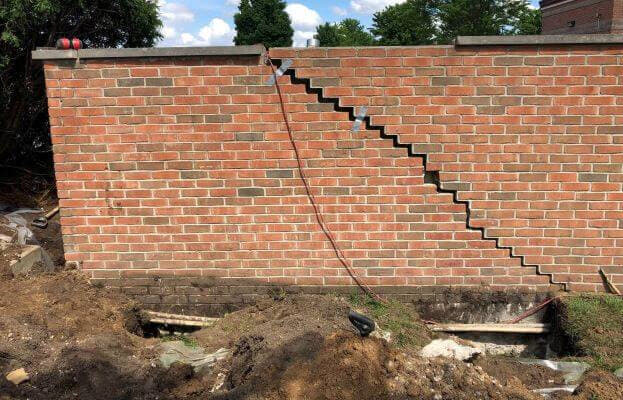
Unfortunately, it’s probably going to take more than drywall putty and paint to make this crack disappear. What you’re seeing is an indication that your home is settling- a sign that something underneath your house has shifted and needs your attention. At Acculevel, we’ve been repairing settling foundations since 1996 and guarantee our work for the life of your home.
We’re going to review the signs of a settling foundation, what causes it, and why you should address it.
Want a faster diagnosis? Check our Symptom Checker for more info.
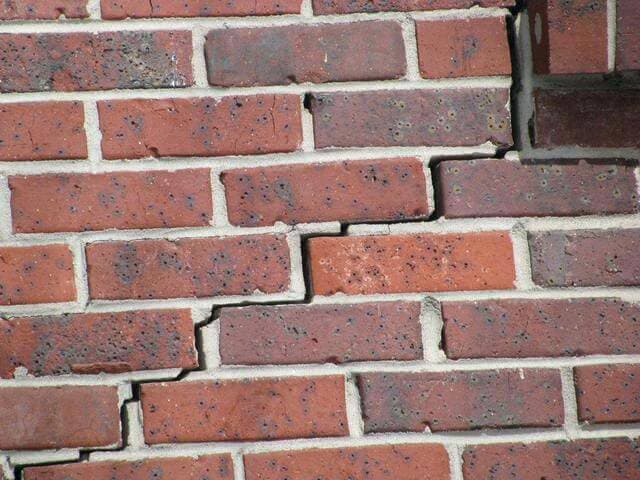
This stair-step crack indicates a settling foundation. This picture was taken by an Acculevel Project Manager on a routine free estimate appointment.
Why is your foundation moving? Generally speaking, it’s caused by changes in the ground surrounding your home. Water saturation is the most common cause. Too much water flowing under or around your home can soften-or even erode-the soil under your footings.
Another possibility is a reduction or lack of soil compaction. When a home is built, the soil is dug out to make room for the foundation. It should be compacted tightly before the foundation is laid, but sometimes this isn’t done thoroughly. Alternately, there could be layers of soil below the compacted area that are of a different (or weaker) composition.
Like many home repairs, this is something you should fix as soon as you can. It will not get better on its own and will worsen over time. In fact, the worse the settling becomes, the more expensive the repairs will be.
If your sinking foundation is left untreated, the pressure it’s exerting on your house will begin to warp the structure itself. Your windows will crack, pipes will be strained and then burst, the walls will bow and give way. If you’d like additional information on bowing walls, we have an article with details here.
Repairing your foundation gives you structural stability, peace of mind, and better resale value for your home.
If you’ve noticed any of these signs, you should do a thorough walk-through of your home. Make a note of any other symptoms of settling that you discover, then find an experienced local foundation company, and make an appointment. Before you sign a contract for any service, you should always verify the company is reputable, insured, and accredited by the Better Business Bureau.
If you live in Indiana or the surrounding states, contact Acculevel. Established in 1996, we specialize in foundation repairs. If you have noticed any of the warning signs in your home, you can request a free estimate. An experienced project manager will evaluate your foundation's condition and recommend the best course of action for you, to keep your home strong and healthy for years to come.
We have also created a free tool that any homeowner can use to see what could be causing problems in your home and how to fix it. Identify problems, explore solutions, and get advice on how and when to take action with our Symptom Checker.
[DISPLAY_ULTIMATE_SOCIAL_ICONS]