✕
What issue are you experiencing?
Cracks, water intrusion, crawl space moisture, settlement, etc.
Cracks, water intrusion, crawl space moisture, settlement, etc.
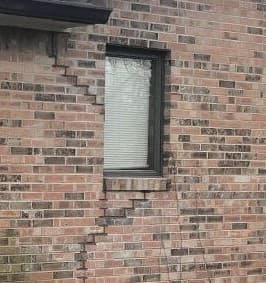
It can be unnerving, to find cracks in your home’s walls, ceiling, or foundation. You don’t know what it means. Is it minor? Just a cosmetic issue? Will your house fall down? I understand how easily reasonable concern can turn into panic.
Since we first opened our doors in 1996, Acculevel has been repairing foundations and restoring health and stability to homes. We are a family-owned and operated business, and we proudly serve Indiana and parts of the surrounding states, such as foundation repair in Bloomington, IL. Our goal is to treat each customer’s home like our own; we will listen to your concerns, address them thoroughly, explain our repair methods, and clearly detail our competitive pricing without high pressure sales tactics.
We are going to address the three major signs of foundation problems, give you additional symptoms to look for, and provide additional resources to help answer all your questions
Let’s start with the big red flag: you’ve found a crack in the foundation itself. This is something that should be repaired, but depending on the type and size of the crack, it may be less frightening than it appears.
If the crack is inside the home, in a basement or crawl space, it’s probably caused by water. Hydrostatic pressure is a fancy term that means water in the soil around your home can push against the foundation and cause damage.
 |
 |
On the left, a hairline crack that was found when it started letting in water. On the right is a basement wall with both horizontal and stair-step cracks. Both of these photos were taken by an Acculevel project manager during free estimate appointments.
Most of the time, a crack on the outside of your home’s foundation indicates a settling problem. Other signs to watch for include:
|
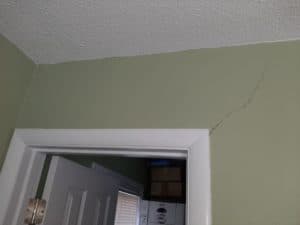 |
On the left, an exterior crack. On the right, a sticking door and cracks in the drywall. Both of these are signs of foundation settling. (And both photos were taken by project managers during free estimate appointments.)
The symptoms I have covered in this article are all foundation-related, but they are not the only possible concerns you may have about your home. Sagging floors are a clear indication of instability and should be repaired promptly, but they are not foundation-specific problems.
We have an article that explains what causes sagging floors, and another that reviews how repairs are performed.
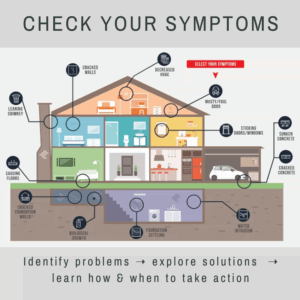
You are also welcome to use our free interactive symptom check, which provides information on causes, repairs, and pricing.
Finding the right contractor to make repairs on your home can be challenging. You can get our top 5 traits to look for in a foundation repair expert, here.
We also have a list of the questions you should ask a contractor, complete with free downloadable form.
And if you’re not sure what symptoms you should be watching out for? You can find our free guide to conducting your own foundation inspection, here. We recommend that you perform this inspection twice a year.
If you would like to have a foundation expert come to your home, and you live within our service area, please contact Acculevel. One of our friendly and knowledgeable project managers will meet with you, listen to your concerns, evaluate your home, then provide a free written estimate.

[DISPLAY_ULTIMATE_SOCIAL_ICONS]